
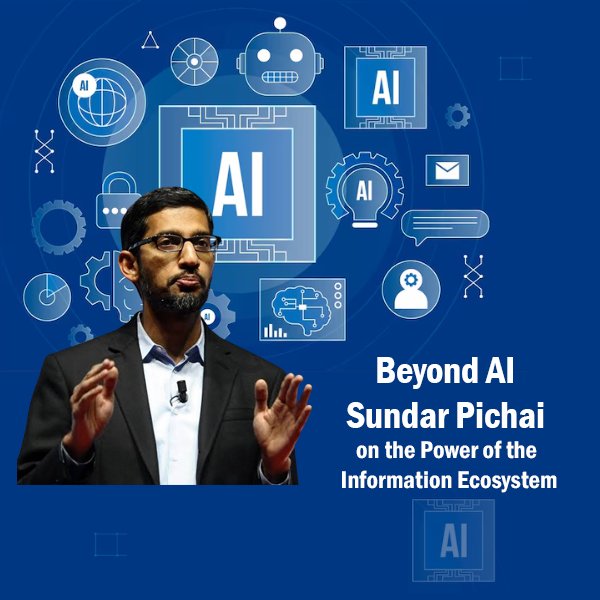
In a recent interview with the BBC, Google CEO Sundar Pichai emphasized a critical perspective on artificial intelligence: AI is not a standalone source of truth. Instead, he highlighted that the broader information ecosystem—comprising search engines, journalism, teachers, doctors, and subject matter experts—remains far richer and more reliable than AI alone.
Pichai’s remarks came in response to questions about the reliability of generative AI tools. He clarified that while AI can generate useful predictions and assist in creative tasks, it does not replace grounded sources of knowledge. Google Search continues to play a vital role in anchoring AI outputs to factual information, ensuring that users can distinguish between statistical predictions and verified truths.
The conversation revealed a tension between narrow views of AI’s accuracy and Pichai’s broader vision of its role in society. While interviewers pressed on whether AI could always be trusted, Pichai consistently zoomed out to stress the importance of the wider ecosystem. He argued that AI should be seen as one tool among many, enabling new opportunities such as film creation or complex problem-solving, but always within the context of human expertise and established information channels.
This perspective is particularly relevant as AI adoption accelerates across industries. By situating AI within the larger forest of information rather than treating it as the lone tree, Pichai underscored the need for balance. The future of knowledge will depend not on AI alone, but on how effectively we integrate it with trusted sources and human judgment.
In essence, Pichai’s message is clear: AI is transformative, but the richness of the information ecosystem ensures that truth, reliability, and expertise remain at the center of progress.
Visual content such as images, videos, and infographics play a crucial role in enhancing understanding and engagement within the information ecosystem. They help convey complex ideas quickly and memorably, complementing textual information and supporting diverse learning styles.
Images can serve as powerful tools for storytelling, evidence presentation, and emotional connection, making information more accessible and impactful. In the context of AI and information, visual data can also aid in transparency, helping users better grasp AI processes, outputs, and limitations.
As Sundar Pichai emphasizes the importance of a rich information ecosystem, integrating visual content thoughtfully ensures that knowledge is not only accurate but also engaging and comprehensible to a broad audience.